

Pallet Jacks
-
When Powered Pallet Trucks Pay for Themselves
Powered pallet trucks make sense when the math starts working against you. An operator pushing a manual jack across a large floor slows down over a shift. That's not a training issue — it's physics, and it shows up in your picks-per-hour number.
The break-even usually comes down to three things: how far your operators travel per move, how many moves they make per shift, and what your labor cost per hour actually is. When travel distance and frequency are both high, powered equipment recovers its cost faster than most people expect.
There's an energy side too. Raymond's third-party testing on the 8410 found 6% faster cycle times and 33% less energy use than the competing model — which translates to fewer battery changes per shift and less charging infrastructure needed overall.
Call 800-926-2546 and we'll talk through what your current setup is costing you in throughput.
Walkie Pallet Jack or Rider? Start With Travel Distance
This is the first real decision, and travel distance answers it faster than anything else. Short, frequent moves favor a walkie. Long runs across a facility favor a rider.
A walkie pallet jack is operated by someone walking alongside it. The operator has full control in confined areas, which makes these models the right pick for dock work, trailer loading, and anywhere aisles are tight or traffic is dense.
The 8210 handles 4,500 lbs on a 28-inch frame. The 8310 steps up to 6,000 or 8,000 lbs in multiple frame lengths — a solid choice if you need power pallet jack 8000 lb capacity without moving to a rider platform.
A rider model gives the operator a platform to stand on. Once travel distances get long enough, that platform stops being a comfort feature and starts being a throughput feature — operators cover ground faster and finish a shift with more left in the tank.
You have four configurations here. The 8410 and 8910 end riders put the operator at the rear. The 8510 center rider positions them mid-truck for better visibility in both directions. The 8810 side entry makes getting on and off faster, which matters when operators are dismounting frequently. All four run 6,000 or 8,000 lbs.
If you're picking from the second load beam occasionally but not enough to justify a dedicated order picker, there's a middle option. The 8720 second-level order picker handles it directly. The 8410 can also be configured with pyramid pick steps accessible from either side — a lower-cost path to the same capability when second-level picking is a part of the job rather than the whole job.
Compare The Raymond 8000 Series Electric Pallet Jacks
Eight models, capacities from 4,500 to 8,000 lbs, multiple frame lengths and widths across the range. If you're shopping for a motorized pallet jack or comparing an electric pallet jack for sale across suppliers, this is the full Raymond lineup in one place. Compare by capacity, configuration, and battery type below. If two models look close and you're not sure which fits, that's a two-minute phone call. Call 800-926-2546 with your load weights and travel distances.
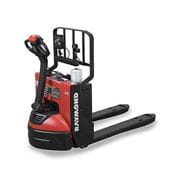
8210 Walkie Pallet Jack
- Capacity: 4,500 lbs.
- Frame Width: 28" overall width
- Battery: 24 volt
Learn More
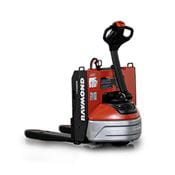
8250 Lithium-ion Pallet Jack
- Capacity: 5,000 lbs.
- Frame Width: 28" overall width
- Battery: 24 volt (26 nominal) Lithium-ion, 78 amp hour
Learn More
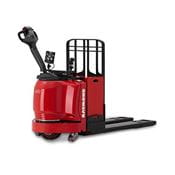
8310 Walkie Pallet Jack
- Capacity: 6,000 lbs. or 8,000 lbs.
- Frame Length: Available in multiple lengths and widths
- Battery: 24 volt
Learn More
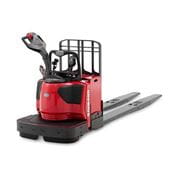
8410 End Rider Pallet Jack
- Capacity: 6,000 lbs. or 8,000 lbs.
- Frame Length: Available in multiple lengths and widths
- Battery: 24 volt
Learn More
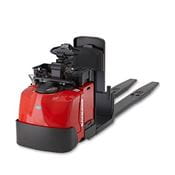
8510 Center Rider Pallet Truck
- Capacity: 6,000 lbs. or 8,000 lbs.
- Frame Length: Available in multiple lengths and widths
- Battery: 24 volt
Learn More
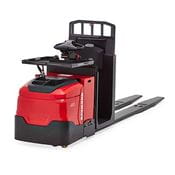
8720 Second Level Orderpicker
- Capacity: 6,000 lbs. or 8,000 lbs.
- Frame Length: Single, Double and Triple Configurations
- Battery: 24 volt
Learn More

8810 Side Entry Pallet Truck
- Capacity: 6,000 lbs. or 8,000 lbs.
- Battery: 24 volt
Learn More
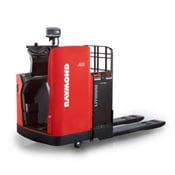
8910 End Rider Pallet Jack
- Capacity: 6,000 lbs. or 8,000 lbs.
- Frame Length: Available in multiple lengths and widths
- Battery: 24 volt
Learn More
Lithium-Ion or Lead-Acid? What Actually Drives the Decision
This is where a lot of buyers get talked into the wrong thing. A lithium ion pallet jack costs more upfront, and whether that premium pays back depends entirely on how you run your operation — not on which technology is newer.
-

When Lithium-Ion Justifies the Premium
Lithium-ion earns its cost in multi-shift operations. It supports opportunity charging, so operators can top off during breaks without damaging the battery. Voltage stays consistent through the shift instead of dropping off. There's no watering, and no battery room, no change-out equipment, and no spare batteries sitting in inventory.
If you're running two or three shifts and currently managing a battery change-out process, the 8250 is built specifically around eliminating that. The savings show up in labor and floor space, not just in the battery itself.
-

When Lead-Acid Is Still the Right Call
If you run a single shift and already have charging infrastructure in place, lead-acid usually remains the better financial decision. The battery charges overnight, runs the shift, and repeats. Paying a lithium premium to solve a problem you don't have doesn't return anything.
We'll tell you which one fits your operation. Sometimes the answer is the cheaper one.
-

How to Spec Your Electric Pallet Jack in Four Steps
Four inputs narrow eight models down to one or two:
-
Travel distance per move — short and frequent points to a walkie; long runs point to a rider platform.
-
Heaviest load — spec above your maximum, not your average. The range runs 4,500 to 8,000 lbs.
-
Shift structure — single shift usually means lead-acid; multi-shift is where lithium-ion starts paying back.
-
Picking requirements — occasional second-level picking may not require a dedicated order picker.
Have those four ready and the conversation gets short.
-
Technology That Moves More Pallets Per Shift
The truck itself is only part of the throughput equation. A few options are worth knowing about before you spec.
Pick2Pallet is a put-to-light system Raymond offers exclusively. LED lights are embedded directly into the forks and indicate where each item should be placed during batch picking. It cuts errors without slowing operators down, which is the usual tradeoff with accuracy tools.
Programmable travel speeds let you tune performance by operator experience level — slower settings for newer operators, full speed once they're up to standard. On the 8410, Raymond's design also lets you set reduced speed to train operators to travel with forks elevated, which prevents undercarriage wear over dock plates.
Call 800-926-2546 to talk through which options fit your picking process.

Still Deciding Between Powered and Manual Equipment?
If your moves are short, infrequent, or happening in a stockroom rather than across a warehouse floor, powered equipment may be more than the job requires. Manual units cost less, need no charging, and handle staging and dock work well. We carry the full Raymond line of manual pallet jacks alongside these, and we'll be straight with you about which direction fits. A walkie rider pallet truck is the right answer for a lot of operations — but not all of them.
Service, Parts, and Battery Support After the Sale
-

Factory-certified technicians
Our service team is trained on Raymond electric equipment specifically, including the electrical systems that a general mechanic won't be set up for. -

Parts availability
We stock Raymond parts. A truck sitting idle waiting on a controller isn't saving anyone money. -

Battery and energy support
Battery management is an ongoing cost unique to electric fleets, and it's something we help operations plan for rather than react to.
Put The Right Powered Pallet Truck To Work
You now know which configuration fits your travel distances, what capacity range you're working in, whether lithium-ion is worth it for your shift structure, and what happens when the equipment needs service. What's left is a short conversation. Bring us your travel distances, load weights, and shift structure — we'll narrow eight models to one, and tell you honestly if a lower-cost option covers what you need. Call 800-926-2546 with your specs, or request a quote on electric pallet jacks.
Interested in a Raymond Pallet Jack? Let's Talk!
A representative will use the information you provide below to develop the best solutions for your operation.
Learn more about electric pallet jack types, battery options, load capacities, and service support.
A walkie pallet jack is controlled by an operator walking alongside it, which gives better control in tight spaces and suits short, frequent moves like dock work and trailer loading. A rider model has a platform the operator stands on, which covers long distances faster and reduces fatigue over a full shift. Travel distance is the deciding factor — if operators are walking a long way on every move, a rider will pay for itself in throughput.
A standard 24-volt lead-acid battery typically runs a full single shift on an overnight charge. Lithium-ion batteries support opportunity charging during breaks, which lets them run multi-shift operations without a change-out. Battery service life depends heavily on charging practices and maintenance — lead-acid needs regular watering and proper charge cycles, while lithium-ion requires neither.
The Raymond 8000 Series runs from 4,500 lbs on the 8210 walkie up to 8,000 lbs across the heavier walkie and rider models. Spec above your heaviest expected load rather than your average — running consistently near a truck's rated ceiling accelerates wear on the drive system. If most of your loads are under 4,500 lbs, the 8210 covers it; anything heavier moves you into the 8310 and up.
For multi-shift operations, usually yes — the savings come from eliminating battery change-outs, the labor around them, and the floor space a battery room occupies. For single-shift operations with charging already in place, lead-acid typically remains the better financial call. The premium pays back when you're solving a real operational problem, not just adopting newer technology.
Electric pallet jacks have drive motors, controllers, and battery systems that require technicians trained on the specific equipment. As an authorized Raymond dealer, we employ factory-certified technicians and stock Raymond parts, which is the practical difference between a truck that's back running in a day and one waiting on a diagnosis. This matters more with electric equipment than manual, since there's simply more that can fail.
Electric Pallet Jack Questions, Answered
What's the Difference Between a Walkie and Rider Pallet Jack?
How Long Does an Electric Pallet Jack Battery Last?
What Capacity Electric Pallet Jack Do I Need?
Are Lithium-Ion Pallet Jacks Worth the Extra Cost?
Who Services an Electric Pallet Jack After You Buy It?
Areas We Serve
Malin supports operations across Texas and Louisiana, with locations serving Addison, Dallas, Fort Worth, Houston, Austin, San Antonio, El Paso, McAllen, and Shreveport.