

-
Superior Productivity And Operator Proficiency With skilled operators in short supply and inexperienced employees covering seasonal demands, lift truck operations in wire guided, very narrow aisle applications need to be as simple as possible to maximize productivity and minimize impacts and damage. Raymond's Zoning and Positioning options allows operators to focus on their surroundings and the task at hand instead of searching for locations, so they learn more quickly, execute more accurately, and work more efficiently through improved intralogistics automation.
-
Zoning Zoning ensures more consistent and reliable truck operation by controlling, restricting, and defining certain truck parameters and behaviors, including travel speed and lift height, at precise locations in specific aisles allowing your trucks to adapt to:
+ Varying ceiling heights
+ Pedestrian cross walks or end-of-aisle stop/slow
+ Restricted or safety zones
+ No entry areas or enforced one-way travel
+ Racking irregularities
+ Congested areas
-
Positioning By coordinating a truck's lift height and speed with a pre-programmed map of your facility, positioning capabilities allow your trucks to minimize travel time by always taking the optimal route between storage locations. With a faster, smoother path to the next task, positioning can:
+ Accelerate the proficiency timeline of new or inexperienced operators
+ Improve picking speed, efficiency, and process flow without compromising accuracy
+ Minimize impacts and facility damage
Compatible Forklift Models
Nowhere are the benefits of zoning and positioning felt more strongly than in very narrow aisle applications. By ensuring your order pickers and swing reach trucks are in exactly the right location as quickly as possible, from one slot to the next, Raymond's Zoning and Positioning solutions offer faster pick rates and pallet movements for superior productivity.
-
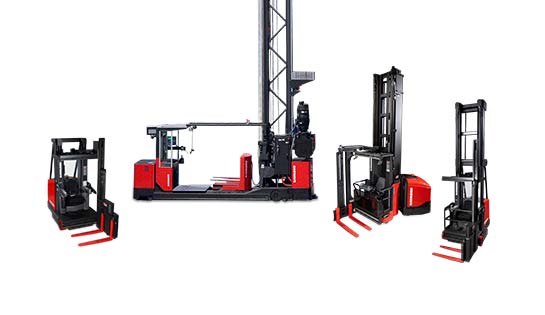
Turret Trucks
Raymond Swing Reach Trucks offer the lift heights and capacities to suit almost any full pallet or case picking application, up to 59 feet. -
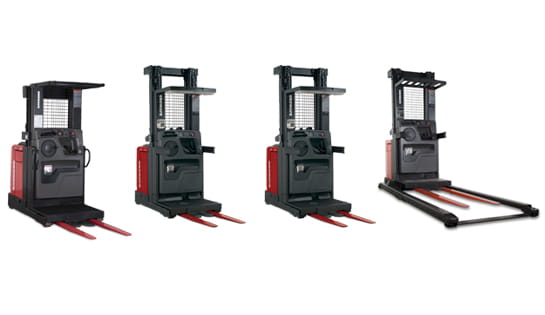
Order Pickers
Raymond Order Pickers are intelligently designed and engineered to deliver faster speeds and less downtime than competitive models.
Interested In Learning More? Let's Talk!
Please complete the form below and a representative will contact you shortly to discuss your request.
Learn more about forklift zoning, automated positioning, speed and lift controls, operator training, and very narrow aisle applications.
Zoning and Positioning (ZaP) is an operator assist technology that uses a pre-programmed map of a facility to control forklift travel speed and lift height at specific locations throughout the warehouse.
Zoning applies programmed truck behaviors in defined areas, such as slowing near pedestrian crosswalks or stopping before restricted zones. Positioning coordinates travel speed and lift height to help guide operators to the correct rack location with less manual searching and adjustment.
Positioning coordinates the forklift's lift height and horizontal position with a stored facility map. As the operator travels through the aisle, the truck can begin moving toward the correct height and rack location. This reduces time spent searching for slots and manually adjusting the mast, helping create faster and more consistent picking cycles in high-SKU environments.
Yes. Travel speed and lift height limits can be programmed for specific aisles or zones based on ceiling heights, racking layouts, pedestrian traffic, and restricted areas. One-way travel can also be assigned to certain aisles. The forklift automatically adjusts its programmed behavior as it moves from one zone to another.
Yes. Because the system assists with navigation, speed controls, and lift positioning, new operators can become familiar with complex warehouse layouts more quickly. Instead of relying entirely on memory for rack locations, height restrictions, and zone rules, operators can focus more closely on completing the assigned task. This can be especially useful for facilities that regularly onboard seasonal or new employees.
ZaP is available on Raymond order pickers and Swing-Reach turret trucks. These models are commonly used in wire-guided, very narrow aisle applications where automated speed control, lift positioning, and rack-location guidance can have the greatest effect on productivity.
A real-time location system tracks and reports where lift trucks, personnel, and assets are located. It gives managers visibility into movement patterns, congestion, and equipment utilization.
Zoning actively controls how a forklift behaves based on its location. It can apply speed restrictions, lift limits, one-way travel rules, and no-entry zones in real time. The two systems complement each other: location tracking identifies patterns and inefficiencies, while zoning applies programmed operating rules directly to the truck.
Frequently Asked Questions About Zoning and Positioning
What is forklift zoning and positioning technology?
How does positioning technology increase picking speed in very narrow aisles?
Can forklift zoning restrict speed or lift height in certain areas?
Does zoning and positioning reduce operator training time?
Which forklift models are compatible with zoning and positioning systems?
How is zoning different from a real-time location tracking system?