

-
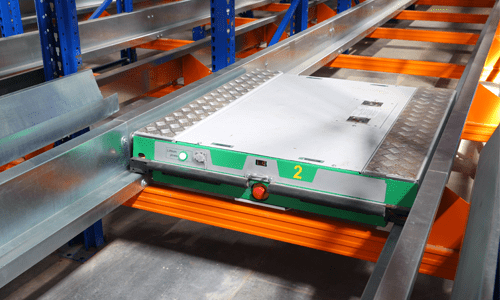
Increase Storage Capacity And Space With warehouse space already at premium for most businesses, the risk of running out of room to store additional goods is always a concern. Automated storage and retrieval systems use horizontal and vertical storage carousels to move product automatically to retrieval locations. This eliminates the need for unnecessary travel down the aisle or between racking by a forklift or other material handling equipment, saving both floor and storage space. Ideal for distribution centers and manufacturing facilities with high volumes of product, ASRS systems provide direct access to items to increase throughput and streamline processes, especially around inventory management.
Benefits Of Automated Storage And Retrieval Systems

Improve Employee Productivity

Increase Your Capacity

Expand Your Capability

Protect Your Products
Automated Storage And Retrieval Systems For Your Operation
With a range of automated storage and retrieval systems available today, we can implement the right solution to meet your unique storage and supply chain requirements. Whether you're handling individual boxes or whole pallets, these solutions offer measurable improvements over traditional storage products.
+ Unit Load ASRS Systems are designed to quickly and reliable transport standardized unit loads, specific to your facility, in-and-out of high density storage.
+ Mini Load ASRS Systems are engineered to store a variety of small parts and products that represent the mid-range of activity in less space with fast performance.
+ Pallet Shuttle ASRS Systems are constructed with deep storage lanes that reduce the need for forklifts to store and retrieve pallets for maximum efficiency.
Each automated system allows you to commit specific areas of your operation for inventory retrieval to maintain order even when demand is high. Plus, by managing the movement of your products using RFID technology the need for physical inventory counts is significantly reduced.
-
Flexible, High Density Storage Radioshuttle is a semi-automated high density storage system that allows for maximum use of your warehouse space while maintaining selectivity between all levels and increasing operational efficiency.
Once it's loaded into storage loads, the Radioshuttle takes commands from a remote control to execute orders by loading or unloading pallets into a lane where pallets are fed by a lift truck.
Goods-to-Person Order Fulfillment Systems
The time it takes to pick and prepare an order is becoming a key differentiator among competitors, especially for companies that have a large volume of e-commerce sales. With a goods-to-person system, products are automatically moved to the operator and shown on a digital screen to indicate exactly which items need to be picked via the warehouse picking solution, eliminating time traveling to a product, picking it from a shelf, and returning with it to be packaged. This technology leads to an increase in accuracy and efficiency and be easily scaled to meet growing demand and expanding SKUs.
Vertical Lift Modules & Industrial Carousels
Increase your storage density for small and medium sized products with vertical lift modules and carousels. From simple, everyday picks to full inventory control, these systems allow you to perform a variety of activities by improving operator productivity and reducing wasted floor space.
-
.png?rev=eec00776fbf54313aa0c805c1cc6aa5b&la=en&h=315&w=545&hash=4309D749F40A286FF1998C594A9290E4)
Vertical Lift Modules (VLMs)
In VLMs, there are two columns of trays with an inserter/extractor in the center that retrieves/delivers the selected shelf to the operator, similar to an elevator. Ideal for applications with:
+ Ceiling heights over 25 feet
+ Parts that have varying dimensions
+ Items that require special assistance for lifting
+ An inventory mix that regularly changes -
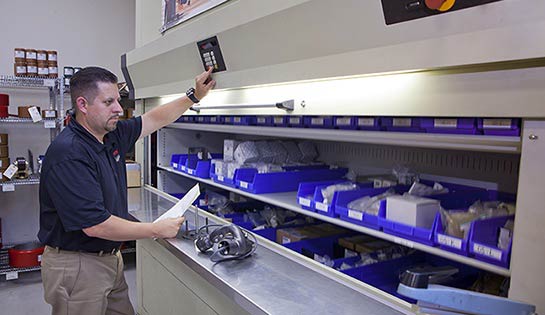
Vertical Carousels
In carousels, a series of bins rotate on an oval track until the desired one reaches the operator, this mimics the motion of a ferris wheel. Ideal for applications with:
+ Ceiling heights under 25 feet
+ Parts that have similar dimensions
+ Items that can be manually picked
Interested In Learning More? Let's Talk!
Please complete the form below and a representative will contact you shortly to discuss your request.
-
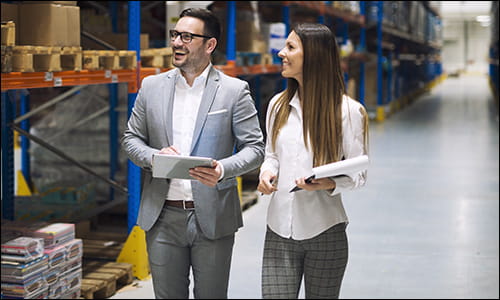
Steps For A Successful Implementation Prior to moving forward with an AS/RS system, your warehouse and processes should first be analyzed and optimized. We can help lay the groundwork for a successful implementation by utilizing the Raymond Lean Management System (RLM) to assess different aspects of your operation. Whether it’s through faster fulfillment, minimized downtime, or improved quality, our certified professionals will ensure you get the most out of your resources.
Learn more about automated storage and retrieval systems, high-density storage, goods-to-person technology, vertical lift modules, pallet shuttles, and warehouse automation.
An automated storage and retrieval system (ASRS) uses horizontal and vertical carousels, shuttles, or cranes to automatically move products to and from storage locations without requiring a forklift or operator to travel through the facility. The result is faster retrieval, a dramatically smaller storage footprint, reduced labor involvement, and continuous 24/7 operation—making ASRS a core technology for high-volume distribution centers and manufacturing facilities managing large inventories in limited space.
By eliminating the wide aisles required for forklifts and reducing reliance on floor-level storage, ASRS solutions maximize both vertical and horizontal space utilization. High-density storage configurations can place significantly more pallet or unit positions within the same building footprint—freeing floor space for other operational functions and removing the need for facility expansion to accommodate inventory growth.
Each is designed for a different load type and throughput requirement. Unit load systems handle standardized loads—typically full pallets—moving them quickly in and out of high-density storage. Mini load systems store smaller parts and products in the mid-range of activity, offering fast performance in a compact footprint. Pallet shuttle systems use deep storage lanes and automated shuttles to store and retrieve full pallets, reducing the number of forklift movements required and maximizing density in block storage applications.
In traditional picking, operators travel to the product. Goods-to-person reverses that—the system automatically delivers the required items to a stationary operator, who sees exactly what to pick on a digital screen. This eliminates travel time between pick locations, reduces physical fatigue, and improves accuracy. It’s particularly effective in e-commerce and high-SKU environments where order profiles are small, frequent, and highly varied.
Yes. Vertical lift modules (VLMs) and vertical carousels are compact, automated storage systems designed for small-to-medium-sized parts and products. A VLM uses two columns of trays with an extractor that delivers the selected tray to the operator, ideal for ceiling heights over 25 feet and items with varying dimensions. Vertical carousels rotate bins on an oval track to bring the desired bin to the operator—better suited for ceiling heights under 25 feet with more uniform part sizes. Both dramatically increase storage density and operator productivity compared to traditional static shelving.
ASRS works best in operations experiencing space constraints, high inventory volumes, labor challenges, or accuracy issues with manual picking—particularly in distribution centers and manufacturing facilities with consistent, high-throughput requirements. Malin’s approach is to analyze and optimize the operation first, using the Raymond Lean Management System to assess workflows before recommending any automation investment. This ensures ASRS is applied to an already-efficient process, maximizing the system’s return and avoiding the cost of automating avoidable inefficiencies.
ROI varies based on facility size, current labor costs, inventory volume, and the specific system implemented. The primary financial drivers are labor cost reduction, space savings (which can eliminate the need for facility expansion), reduced product damage from automated gentle handling, and inventory accuracy improvements through RFID tracking that reduce physical count labor. Malin’s engineering team develops ROI models as part of the design process, giving operations a clear picture of expected payback timelines before committing to an investment.
Frequently Asked Questions About Automated Storage and Retrieval Systems
What is an automated storage and retrieval system?
How can an ASRS increase warehouse storage capacity?
What is the difference between unit load, mini load, and pallet shuttle ASRS systems?
How does a goods-to-person system improve order fulfillment efficiency?
Are vertical lift modules and carousels considered ASRS solutions?
How do you determine if ASRS is the right solution for a facility?
What is the typical return on investment for an automated storage and retrieval system?