

-
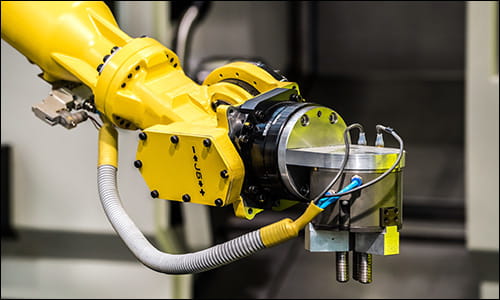
Streamline Your Operations From tools that rapidly handle small parts and products to palletizing robotic arms that make assembly and disassembly easy at the dock door, industrial robots are an excellent step into warehouse automation. We can design, program, and maintain a robotic system to help you streamline operations. Our experts will consult on your robotics needs and put together a solution complete with software, controls, and vision systems, ensuring these robots integrate with your existing equipment and technology.
Maximize Your Labor Force
As labor becomes harder to find and more expensive to hire, robotic solutions can offer a way to enhance your overall productivity. By utilizing robotics to handle some of the mundane, repetitive tasks normally assigned to your employees, you can reduce ergonomic strain and free up your labor to accomplish more value-driven jobs. Implementing industrial robotics into your operations can provide:
+ Unparalleled Accuracy: Robotic palletizers are software-directed for proper load placement
+ Exceptional Flexibility: Robotic systems can be repurposed; end effectors can be switched out to handle different load types
+ Lower Labor Costs: Automated pallet building reduces worker strain and frees operators for other tasks
+ Quite Operation: Servo-based, robotic palletizers generate low noise levels
+ Reduced Product Damage: Gentle handing prevents package and product damage
+ Increased Speed: The systems will improve productivity rates
Industrial Robotics Applications

Load Building
Manufacturing

Transportation

Warehousing
Popular Robotic Solutions
Automate repetitive tasks and take the ergonomic strain off workers with a wide selection of industrial robots. From robotic pallet assembly and disassembly to picking activities, we can help evaluate different options to optimize and then automate a variety of daily material handling tasks.
-
.png?rev=6afef5d7774f47689b07ebc904e7492c&la=en&h=315&w=545&hash=736DB1358A2098EAC4E157ACA15FF1FE)
Robotic Palletizing & Depalletizing
Palletizing systems recieve objects from a conveyor line and place them on a pallet while the opposite is done for depalletizing. In both cases, robots can also handle pallets, slip sheets, and tier sheets to keep products moving at a constant level. -
.png?rev=272a2d5f2ac544c2b6d18c9a4e599608&la=en&h=315&w=545&hash=D457EC8600F55F5432F6501CA51457AC)
Robotic Case Packing
Packing systems can automate end-of-line processes to optimize packing of single or multiple cases per cycle. End of arm tooling (EOAT) can be quickly changed to allow the same robot to handle products with different shapes and sizes. -
.png?rev=0538372ca98a4e0086fcd501b518190b&la=en&h=315&w=545&hash=DA2C6A95AD79F4E7BA5241C5ABEF4CBD)
Robotic Picking Systems
High-speed pick and place robotic systems move products from one location to another with the utmost accuracy. These robots easily automate tasks that require repetitive motion over an extended period of time.
Interested In Learning More? Let's Talk!
Please complete the form below and a representative will contact you shortly to discuss your request.
-
Steps For A Successful Implementation Prior to selecting any industrial robotics, your warehouse and processes should first be analyzed and optimized. We can help lay the groundwork for a successful implementation by utilizing Raymond Lean Management (RLM) to assess different aspects of your operation. Whether it’s through faster fulfillment, minimized downtime, or improved quality, our certified professionals will ensure you get the most out of your resources.
Learn more about industrial robotics, robotic palletizing, depalletizing, robotic picking, warehouse automation, and systems integration.
Malin designs, programs, and maintains a range of industrial robotics systems for warehouse and distribution applications. Solutions include robotic palletizing and depalletizing systems, robotic case packing, and high-speed pick and place robotic picking systems. Each system is delivered complete with software, controls, and vision systems—and is engineered to integrate with existing conveyors, material handling equipment, and warehouse technology platforms already in place.
Robotic palletizers receive products from a conveyor line and build pallet loads with software-directed precision—handling pallets, slip sheets, and tier sheets continuously without operator intervention. This eliminates one of the most physically demanding jobs in a facility, removes a common throughput bottleneck at the end of a production or fulfillment line, and enables consistent, accurate load building at speeds manual palletizing cannot match across extended shifts.
Palletizing assembles products onto a pallet—typically at the end of a production or packing line prior to shipping. Depalletizing is the reverse: removing products from an incoming pallet and routing them to storage or processing locations. Robotic picking systems handle high-speed pick and place tasks, moving individual products from one location to another with precision—suited for repetitive sorting, order fulfillment, and line-feeding applications where consistency and speed are critical.
Yes. Integration is a core part of Malin’s robotics implementation process. Robotic systems are engineered to work within the existing material handling environment—connecting to conveyor in-feeds and out-feeds, communicating with warehouse management software, and coordinating with other automated equipment already in operation. This approach protects existing technology investments and avoids the disruption of replacing functional infrastructure to accommodate new automation.
Robotics are most effective when applied to tasks that are repetitive, physically demanding, or difficult to staff consistently—palletizing, depalletizing, and case packing being prime examples. Automating these tasks reduces the headcount required for high-volume, physically taxing roles, lowers workers’ compensation exposure from repetitive motion injuries, and frees employees to focus on higher-value work that genuinely requires human judgment. Servo-based robotic systems also operate quietly, making them well suited for shared work environments.
Yes. One of the practical advantages of modern warehouse robotics is their flexibility. End effectors and end-of-arm tooling can be switched out to handle different load types, sizes, and shapes—allowing the same robotic system to be repurposed as the product mix evolves. Systems can also be expanded or reconfigured as throughput requirements increase, making robotics a durable long-term investment rather than a fixed-use capital asset.
ROI depends on the specific application, current labor costs, shift structure, and volume, but the primary financial drivers are labor cost reduction, increased throughput, and reduced product damage from consistent gentle handling. Operations running high-volume, repetitive tasks across multiple shifts typically see the strongest payback. As with all automation investments, Malin recommends analyzing and optimizing operations first using Raymond Lean Management before committing to a robotics solution—ensuring the system is applied where it will deliver the greatest measurable return.
Frequently Asked Questions About Industrial Robotics
What types of industrial robotics solutions do you provide?
How can robotic palletizing systems improve warehouse efficiency?
What is the difference between palletizing, depalletizing, and robotic picking systems?
Can warehouse robotics integrate with existing conveyors and WMS platforms?
How do robotic automation systems help reduce labor costs and ergonomic strain?
Are robotic systems scalable as business demands grow?
What is the typical return on investment for industrial robotics automation?