

-
Reinforce Best Practices Raymond's In-Aisle Detection System helps reinforce best practices for lift truck operation which makes for more confident operators. With fast pick requirements, the system alerts operators when objects are detected in the truck's path and brings the vehicle to a controlled stop. While every operator must still follow their training and look in the direction of travel, this In-Aisle Detection System enhances an operator's awareness of their surroundings.
Three Layers Of Security
When an object is detected in a truck's path, operators are alerted.
-

Audible Alarm -

Visual Alert -

Controlled Stop Functionality
An operator can then continue operation of the truck, but speed is limited to 1 mph until the object has been removed.
Compatible Forklift Models
Available as an option on Raymond Order Picker and Swing Reach models, the In-Aisle Detection System assists in keeping trucks separated while on wire guidance in the aisle, enhancing operator security and confidence in very narrow aisle applications.
-
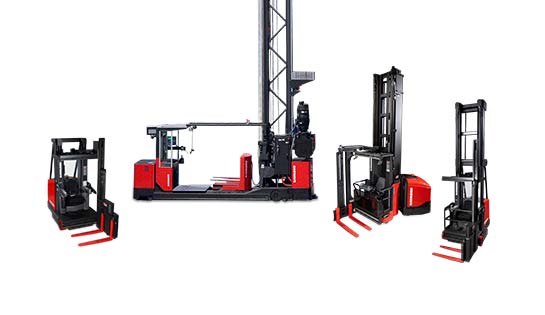
Turret Trucks
Raymond Swing Reach Trucks offer the lift heights and capacities to suit almost any full pallet or case picking application, up to 59 feet. -
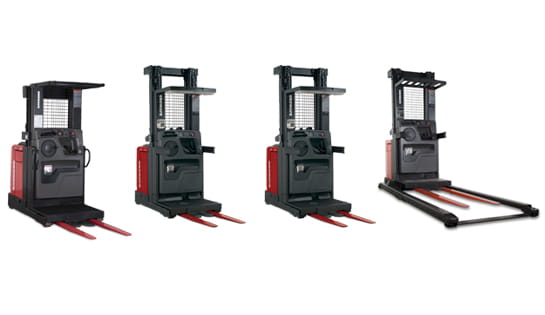
Order Pickers
Raymond Order Pickers are intelligently designed and engineered to deliver faster speeds and less downtime than competitive models.
Interested In Learning More? Let's Talk!
Please complete the form below and a representative will contact you shortly to discuss your request.
Learn more about forklift in-aisle detection, LiDAR object sensing, controlled stopping, operator training, and compatible very narrow aisle equipment.
The In-Aisle Detection System (IADS) is an operator assist technology that uses a LiDAR sensor to detect objects within 30 feet of a forklift's path in wire-guided, very narrow aisle applications. When an obstruction is detected, the system alerts the operator and brings the truck to a controlled stop, adding an automated layer of awareness that supports the operator's training and judgment.
In very narrow aisle environments, operators have limited visibility and little room to react. IADS continuously scans the travel path using LiDAR and triggers an audible alarm, a visual alert, and an automatic controlled stop when an object is detected.
After the truck stops, the operator can resume travel, but speed is limited to 1 mph until the obstruction has been removed from the path. Normal travel speed can resume once the aisle is clear.
No. IADS is designed to reinforce recommended operating practices, not replace operator training. Operators must continue to follow their training and look in the direction of travel. The system adds awareness when visibility is limited or when reaction time alone may not be enough, but proper forklift operator training remains essential.
The system responds with an audible alarm, a visual alert on the operator display, and a controlled stop. After the truck stops, the operator may resume movement, but travel speed is automatically limited to 1 mph until the object is no longer detected in the travel path.
IADS is available as an option on Raymond order picker and Swing-Reach turret truck models. These lift trucks are commonly used in wire-guided, very narrow aisle racking environments where the system's object detection and controlled stopping functions are most applicable.
Yes. By detecting obstructions and automatically bringing the truck to a controlled stop, IADS can help reduce collisions involving lift trucks, racking, products, and personnel. Fewer collisions can mean less product damage, fewer equipment repairs, and more consistent operation in high-throughput, very narrow aisle environments.
Frequently Asked Questions About In-Aisle Detection Systems
What is an in-aisle detection system for forklifts?
How does a forklift collision avoidance system work in very narrow aisles?
Does the In-Aisle Detection System replace operator training?
What happens when an object is detected in the forklift's path?
Which forklift models are compatible with the In-Aisle Detection System?
Can an in-aisle detection system reduce warehouse accidents and product damage?