
The term “Intralogistics Solutions” is increasingly used in the supply chain, popping up in brochures, webinars and virtual meetings alike. But what does it really mean? At Malin, we refer to intralogistics solutions as the mix of processes, technologies, and products required to complete any task related to the movement of materials within a facility.
The key to successfully implementing intralogistics solutions is optimizing before you automate. This process will not only improve material handling functions, but also create a culture of continuous improvement throughout your organization. We believe this approach is essential to developing the right customized solution for your business.
-
 Your people and processes to identify areas of waste and make continuous improvements
 -
 Your facility with smart, scalable technologies that help collect and analyze real-time data
 -
 Your operation to reduce labor, increase throughput, and further enhance productivity
-
Optimization begins by introducing lean management principles to reduce waste through visualization, standardized work, and target-based key performance indicators (KPIs). When applied correctly, a lean management system can effectively and efficiently produce optimized processes of sound quality that fully satisfy customer demands.
Raymond Lean Management (RLM) procedures and techniques are based on the world-renowned Toyota Production System (TPS), which takes a holistic approach to problem solving to create an optimized facility that has more space for product, higher workforce productivity, and leverage intralogistics solutions for suitable tasks among other benefits.
Since there will always be opportunities for improvement, it's vital to consistently analyze and evaluate your business. Using baseline efficiency established with lean management in warehousing, we can help guide future decisions around investing in the right technologies for your application, the best ways to keep your facility connected, and, when you’re ready, technologies that can automate processes to further enhance your productivity.
Interested In Learning More? Let's Talk!
Please complete the form below and a representative will contact you shortly to discuss your request.
-
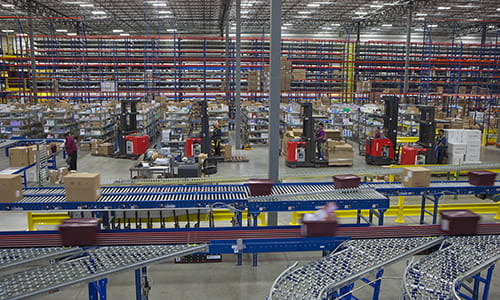
Complete Intralogistics Solutions We are committed to providing an unmatched portfolio of intralogistics solutions that work together to complete virtually any task within your facility. With comprehensive offerings that include material handling equipment, connected technologies, and automated systems, we have the solutions to your problems. Plus, we manage every aspect of the integration process to further enhance performance and productivity throughout your operation.
Learn more about warehouse optimization, intralogistics solutions, lean management, automation planning, and improving operational performance.
Warehouse optimization services analyze how materials, people, and equipment move through a facility to identify waste, inefficiencies, and bottlenecks. Malin evaluates labor utilization, operator productivity, traffic patterns, and space utilization to build a data-driven path toward higher throughput and lower operating costs before capital investments are made.
Intralogistics refers to the processes, technologies, and equipment used to manage material movement within a facility. An intralogistics solution can address the material handling equipment operators use each day, connected technologies that collect real-time performance data, and automated systems that reduce labor dependency and increase throughput.
Lean management principles such as standardized work, workplace organization, visual management, and KPI tracking help operations identify where valuable hours are lost to unnecessary travel, waiting, or inefficient processes. The result is a leaner operation that can accomplish more with the same or fewer resources while reducing per-unit operating costs.
Warehouse optimization improves how people and processes function within the existing operation. Warehouse automation adds technology that can reduce labor dependency and increase speed.
Malin's approach is to optimize before automating. Automating an inefficient process may only cause that process to run faster while increasing the cost of the underlying inefficiency.
Raymond Lean Management, built on the Toyota Production System, applies waste elimination, standardized work, and continuous improvement to warehouse and distribution environments. This approach can create more usable space, improve workforce productivity, and establish a stronger foundation for future technology investments.
Warehouse optimization is especially valuable when an operation is experiencing declining productivity, rising labor costs, space constraints, or inconsistent fulfillment performance. It is also an important first step before expanding a facility, implementing automation, or upgrading material handling equipment.
Any facility that depends on efficient material movement can benefit from intralogistics optimization, but the impact is often greatest in high-SKU, high-volume environments. Distribution centers, third-party logistics providers, e-commerce fulfillment operations, food processing facilities, and manufacturing plants may see significant gains, especially when facing labor shortages, space constraints, or rising operating costs.
Frequently Asked Questions About Warehouse Optimization
What are warehouse optimization services?
What does intralogistics solutions mean?
How can warehouse optimization improve productivity and reduce labor costs?
What is the difference between warehouse optimization and warehouse automation?
How does lean management apply to warehouse operations?
When should a business invest in warehouse optimization services?
What types of facilities benefit most from intralogistics optimization?